


Mutual Funds offer diversified investment avenues catering to various financial goals and risk profiles.
An equity Scheme is a fund that –
The objective of an equity fund is generally to seek long-term capital appreciation. Equity funds may focus on certain sectors of the market or may have a specific investment style, such as investing in value or growth stocks.
Equity Fund Categories as per SEBI guidelines on Categorization and Rationalization of schemes:
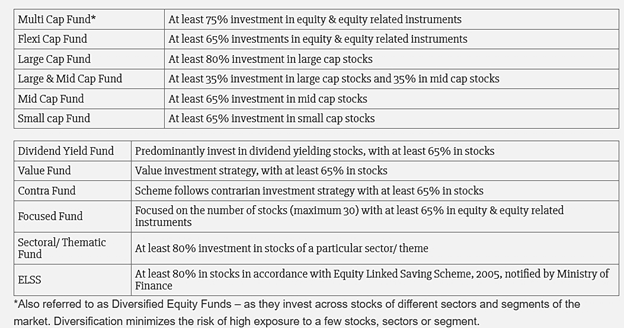
Sectoral funds invest in a particular sector of the economy such as infrastructure, banking, technology or pharmaceuticals etc.
Examples of Sector Specific Funds — Equity Mutual Funds with an investment objective to invest in:
Thematic funds select stocks of companies in industries that belong to a particular theme — for example, Infrastructure, Service industries, PSUs or MNCs.
They are more diversified than Sectoral Funds and hence have lower risk than Sectoral funds.
Equity funds may be categorized based on the valuation parameters adopted in stock selection, such as:
Equity funds may hold a concentrated portfolio to benefit from stock selection.
Contra funds are equity mutual funds that take a contrarian view on the market.
As per the SEBI guidelines on Scheme categorization of mutual funds, a fund house can either offer a Contra Fund or a Value Fund, not both.
1407, Parinee Crescenzo, B-Wing, G Block, BKC, Bandra(East), Mumbai-400051
Follow Us On:
Connect us:[email protected]
Contact number:+91 8958212121
Disclaimer: Risify Funds Pvt Ltd is an AMFI registered Mutual Fund Distributor under AMFI Registration Number: 311352 (valid from 11-10-2024 to 10-10-2027). Risify Funds Pvt Ltd is also registered with APMI having registration no: APRN05107. Mutual funds & Securities are subject to market risks, please read all your scheme/securities-related documents carefully before investing.
AMFI Registered Mutual Fund Distributor (ARN-311352)
APMI Registered PMS Distributor (APRN05107)
AIF Distributor
ARN valid From: 11 October 2024
ARN valid Till: 10 October 2027
© 2024 Risify Wealth. All rights reserved, Built with in India