


A debt fund (also known as income fund) is a fund that invests primarily in bonds or other debt securities.
Debt funds invest in short and long-term securities issued by government, public financial institutions, companies — Treasury bills, Government Securities, Debentures, Commercial paper, Certificates of Deposit and others.
Debt funds can be categorized based on the tenor of the securities held in the portfolio and/or on the basis of the issuers of the securities or their fund management strategies, such as:
Debt funds have potential for income generation and capital preservation.
Debt Fund Categories as per SEBI guidelines on Categorization and Rationalization of schemes:
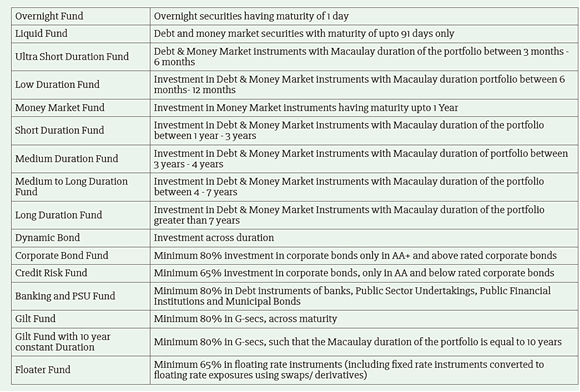
Dynamic Bond funds alter the tenor of the securities in the portfolio in line with expectation on interest rates. The tenor is increased if interest rates are expected to go down and vice versa.
Floating rate funds invest in bonds whose interest are reset periodically so that the fund earns coupon income that is in line with current rates in the market, and eliminates interest rate risk to a large extent.
The primary focus of short-term debt funds is coupon income. Short term debt funds have to also be evaluated for the credit risk they may take to earn higher coupon income. The tenor of the securities will define the return and risk of the fund.
Capital Protection Oriented Funds are close-ended hybrid funds that create a portfolio of debt instruments and equity derivatives.
1407, Parinee Crescenzo, B-Wing, G Block, BKC, Bandra(East), Mumbai-400051
Follow Us On:
Connect us:[email protected]
Contact number:+91 8958212121
Disclaimer: Risify Funds Pvt Ltd is an AMFI registered Mutual Fund Distributor under AMFI Registration Number: 311352 (valid from 11-10-2024 to 10-10-2027). Risify Funds Pvt Ltd is also registered with APMI having registration no: APRN05107. Mutual funds & Securities are subject to market risks, please read all your scheme/securities-related documents carefully before investing.
AMFI Registered Mutual Fund Distributor (ARN-311352)
APMI Registered PMS Distributor (APRN05107)
AIF Distributor
ARN valid From: 11 October 2024
ARN valid Till: 10 October 2027
© 2024 Risify Wealth. All rights reserved, Built with in India